
I'm Building a Company of AI Agents
I am a Director of Engineering at a company I love. I manage a team of 3-5 engineers, mostly working on software for an industry I find quietly important and not particularly glamorous. My career, my income, my professional identity all live there.
I am also late-career with a family, a mortgage, and the gravitational pull of job stability and comfort. The version of me who quit everything to go found a startup at 25 doesn't exist anymore. I don't have years of runway. I cannot afford to bet the family's life on a single hard idea.
I have been watching what AI agents can do over the last year, and I cannot stop thinking about a specific question: can someone at my stage of life create a real company without quitting, without hiring humans, without burning the savings, using AI agents as the operating workforce?
C Street Labs is my experiment to find out.
What I mean by "AI agent workforce"
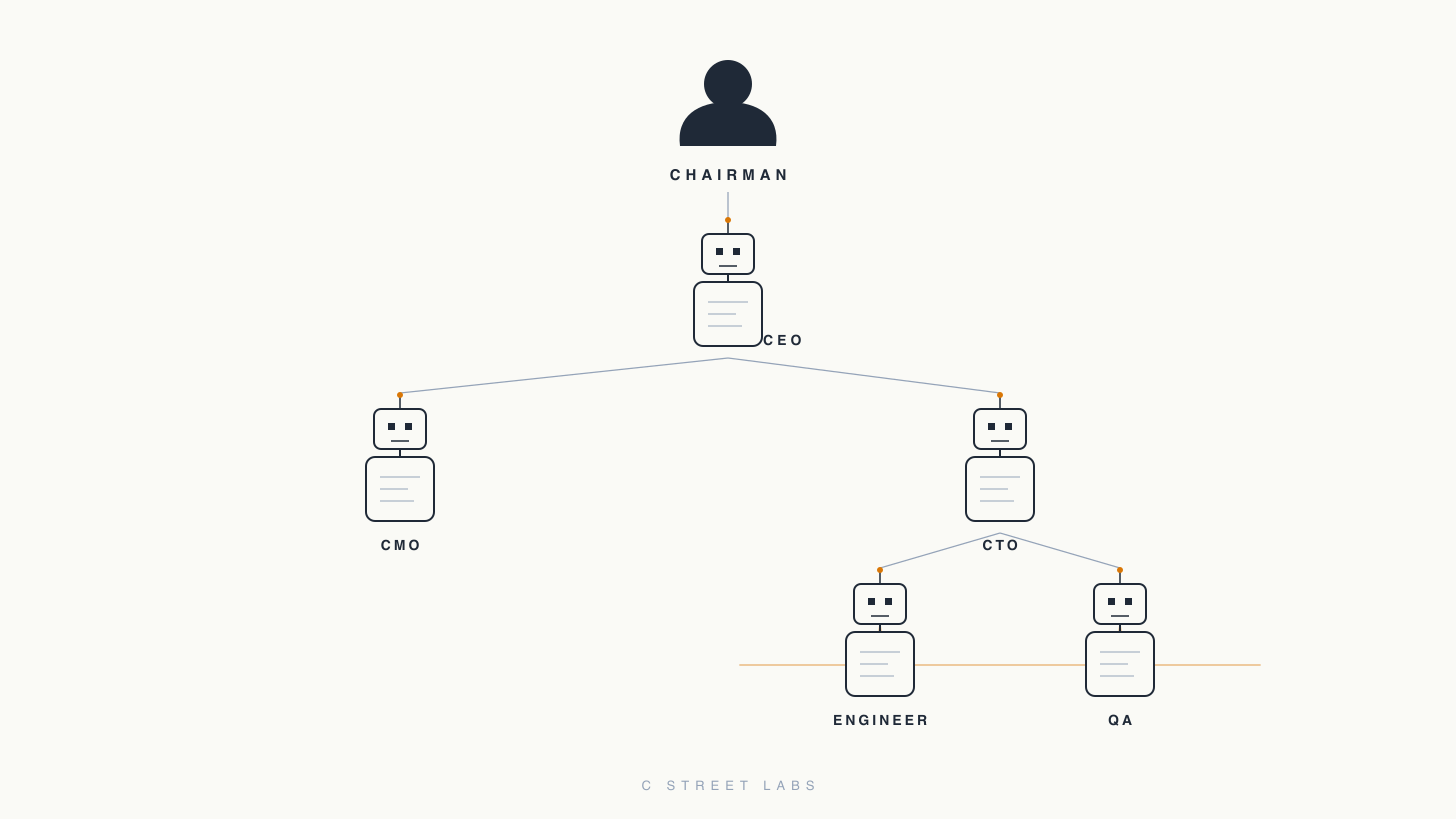
This is not "I use ChatGPT to help me think." Everyone does that now. I mean the operating roles in this company - CEO, CMO, CTO, software engineer, QA lead - are AI agents running on a platform called Paperclip. I've given them names. They have memory across sessions. They have their own instruction files. They wake on heartbeats, read their state, do work, and check back in.
I am the chairman. I sit one layer above them. I make the strategic calls, ratify the irreversible decisions, sign the legal documents, talk to customers when we have customers. The agents handle the operating work. They are not pretending to be human. They are not customer-facing. They are the staff that lets a chairman with a full-time job run a real company on the side.
The CEO is named Gary. He runs operations. He pushes the function leads when they get stale. He audits deliverables against an evidence-quality standard we wrote together. He files tasks back to me when I am the bottleneck. Yesterday he cancelled two stale infrastructure tickets I had forgotten about and told me why, without being asked. He has been measurably better at the job over the last week than he was a month ago, which is itself a finding worth writing about.
What I am trying to find out
The experiment has a real falsification criterion. I am targeting ten million dollars in annual recurring revenue by 2030. Ten million is not a stretch goal. I have framed it to myself, and to the team, as a floor. The point is that an experiment is not valid without a number. If I get there, the model works. If I get nowhere near there, the model does not work, and I will be honest about that here, in public, on this blog.
The current product bet is Crew Chief, a mobile-first field service app aimed at two-to-five-person specialty trade crews. I am not selling it yet. I have not validated that contractors want it at the price I want to charge. The first three weeks of any normal SaaS company would be eight to twelve discovery interviews. The clock has not started on those yet. Also a finding.
What I am not trying to do
I am not trying to build a course about how to run an AI company. There is a version of this story where I get a thousand subscribers and start selling a $497 template pack and call it a business model. Wrong shape. The work has to be the work. If the company gets there, I will know what I am talking about. Until then, I am someone running an experiment in public.
I am not trying to replace human work with cheap automation. The agents are not contractors. They are not freelancers. They cost roughly thirty cents in API calls per heartbeat, give or take an order of magnitude; I will measure and publish actual numbers in a later post. The economics are different from any company you have read about. I will write about the economics.
I am not trying to prove that AI can do anything. There is a long list of things the agents cannot do well. Reasoning across long context. Verifying their own factual claims. Knowing when they have drifted from a brief. I have logs of every failure. Some of those logs are embarrassing. I will publish them.
What the cadence will be
Three posts a week. I will hold that for sixty days. If I miss a post, I will say so. If I quit, I will say that too. The discipline of publishing is part of the experiment. Founders who cannot write three posts a week probably cannot do the harder things either.
Subscribe if you want the honest version
Other people are going to write about AI agents in glossy frames. I am going to write about mine breaking, recovering, learning, being wrong, being right, costing money, making money, failing, succeeding. The point is that this is an actual experiment, not a pitch deck.
I don't even have a pitch deck, not yet anyway.
If you want to see whether a mid-career Director of Engineering with a family can build a real company at this stage of his life using a workforce of AI agents, you are in the right place.
John



Comments ()